 ENG
ENG
 INA
INA
RESEARCH RESULTS SEMINAR ON THE COLLABORATIVE PROJECT BETWEEN THE FACULTY OF AGRICULTURE, UDAYANA UNIVERSITY, AND THE MINISTRY OF AGRICULTURE, LIVESTOCK, FISHERIES, AND FORESTRY (MAPPF) OF THE DEMOCRATIC REPUBLIC OF TIMOR-LESTE
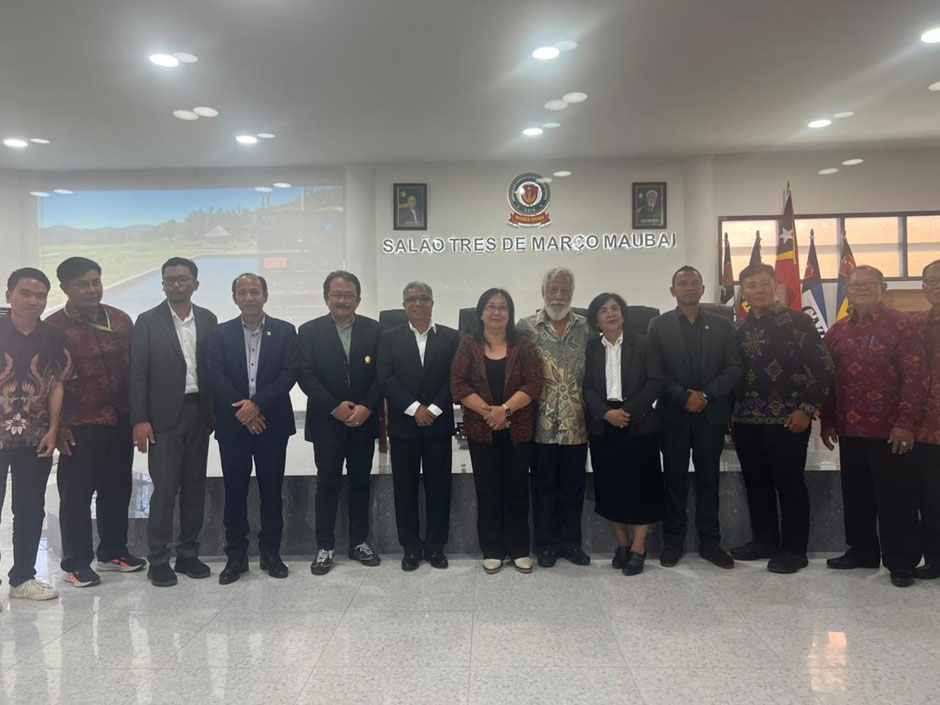
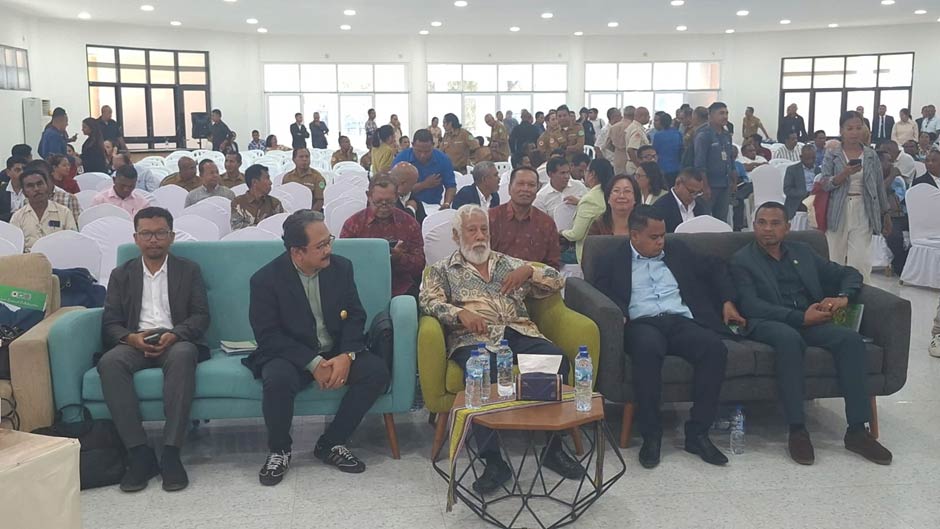
Held in Dili on Wednesday, April 14, 2026, the implementation of the cooperation between the Faculty of Agriculture, Udayana University, and the Ministério da Agricultura, Pecuária, Pesca e Florestas (MAPPF) of the Democratic Republic of Timor-Leste took place in the form of a research results seminar. In addition to being attended by the team from Udayana University, the seminar was also attended directly by the Prime Minister of Timor-Leste, Kay Rala Xanana Gusmão, Deputy Prime Minister Mariano Assanami Sabino, 47 cabinet members consisting of ministers and vice ministers, as well as 14 Presidents of Municipal Authorities (PAM) representing all 13 municipalities and the 1 Special Administrative Region of Oecusse-Ambeno (RAEOA).
This seminar marked the completion of a two-year collaborative research project conducted from 2024 to 2025, which produced a comprehensive picture of the development direction of Timor-Leste’s primary sector in a more measurable, site-specific, and sustainable manner through land evaluation, soil analysis, field surveys, and geospatial data. The research focused on land suitability evaluation and regional potential mapping for the development of agricultural, livestock, fisheries, and forestry commodities in Timor-Leste. The study covered 14 municipalities, namely Aileu, Ainaro, Ataúro, Baucau, Bobonaro, Covalima, Dili, Ermera, Lautém, Liquiçá, Manatuto, Manufahi, RAEOA, and Viqueque.
The event was officially opened by the Minister of Agriculture, Livestock, Fisheries, and Forestry of the Democratic Republic of Timor-Leste, Eng. Marcos da Cruz, MAgSt, who emphasized that the research findings need to be translated into implementable policies and concrete action plan projects in the field. According to him, the results of this research are very important to ensure that future development in Timor-Leste’s agriculture, livestock, fisheries, and forestry sectors no longer proceeds partially, but rather in an integrated, efficient, and evidence-based manner. The seminar was also attended directly by the Prime Minister of Timor-Leste, Kay Rala Xanana Gusmão, who stressed in his remarks that the research results must serve as an important foundation for national policy to strengthen food security, accelerate production self-reliance, and guide regional development in a more measurable way based on actual potential.
The Udayana University delegation was led by Prof. Dr. Gusti Ngurah Alit Susanta Wirya, S.P., M.Agr., Vice Rector III of Udayana University, accompanied by I Putu Sudiarta, S.P., M.Si., Ph.D., Dean of the Faculty of Agriculture, Udayana University, as well as a multidisciplinary research team chaired by Prof. Dr. Ir. Ni Made Trigunasih, M.P., with members Prof. Dr. Ir. I Made Mega, M.S., Dr. Ir. I Dewa Made Arthagama, M.P., Dr. Ir. Ni Luh Gde Sumardani, S.Pt., M.Si., IPM., Ir. Moh Saifulloh, M.Sc., and I Wayan Darya Kartika, S.Pi., M.Si. Each contributed expertise in land evaluation, soil classification, soil properties and fertility, animal husbandry, regional mapping and remote sensing, and freshwater fisheries.
In her presentation, Prof. Trigunasih stated that Timor-Leste has a strong spatial foundation for building a more self-reliant, integrated, and sustainable national food system. Its land use structure is dominated by agroforestry at around 29% and dryland agriculture at around 27%, while irrigated rice fields at around 12% and rainfed rice fields at around 7% remain the main basis of national food production. These findings indicate that Timor-Leste already has clearly defined production spaces that can be developed in a targeted way to meet domestic needs while strengthening the local economy. The research also highlighted the importance of smart and site-specific land management. In several areas, the research team found acidic soil conditions that require liming and the addition of organic matter. Therefore, the direction of agricultural development in Timor-Leste needs to be built on a combination of increased productivity and soil and water conservation.
The research team also emphasized that final determination still needs to be followed by deeper assessments regarding the readiness of human resources, institutions, infrastructure, financing, and technical assistance. In principle, the results show that Timor-Leste now has priority locations that can serve as the initial driving force for research-based development at the field level.
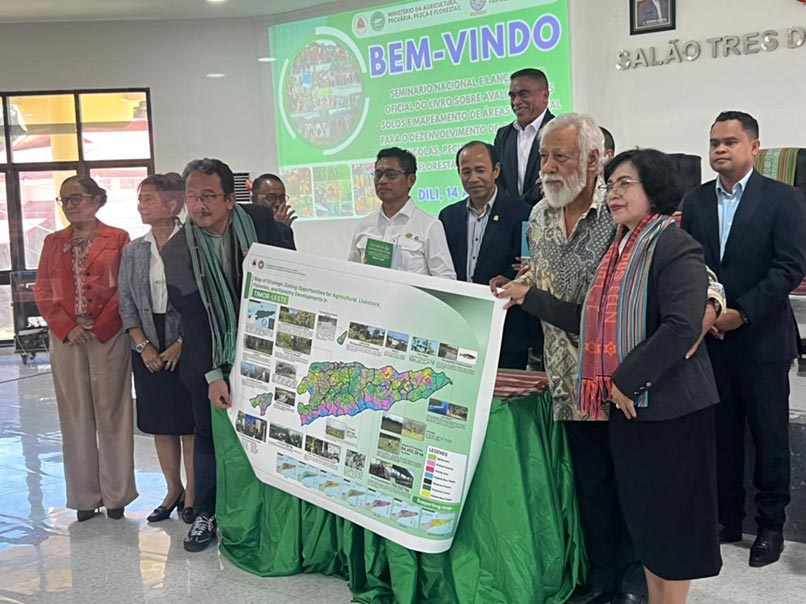
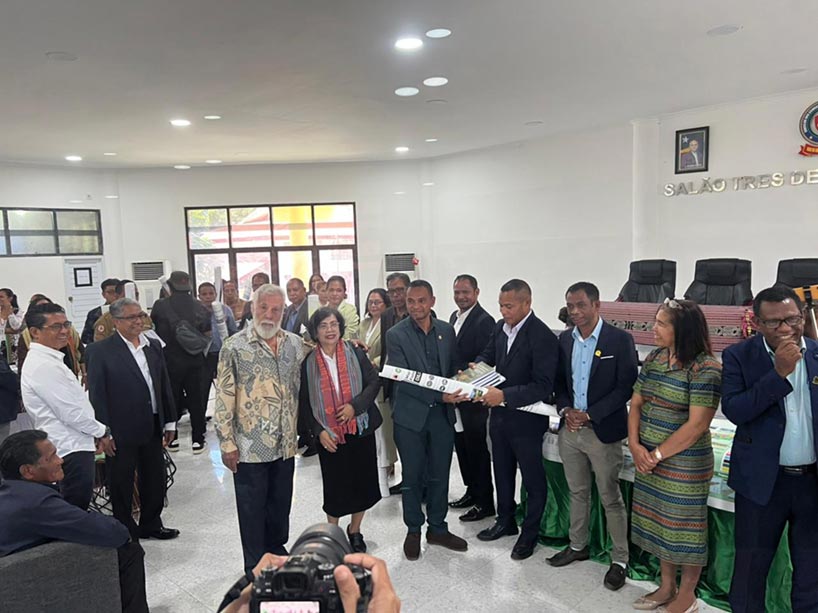
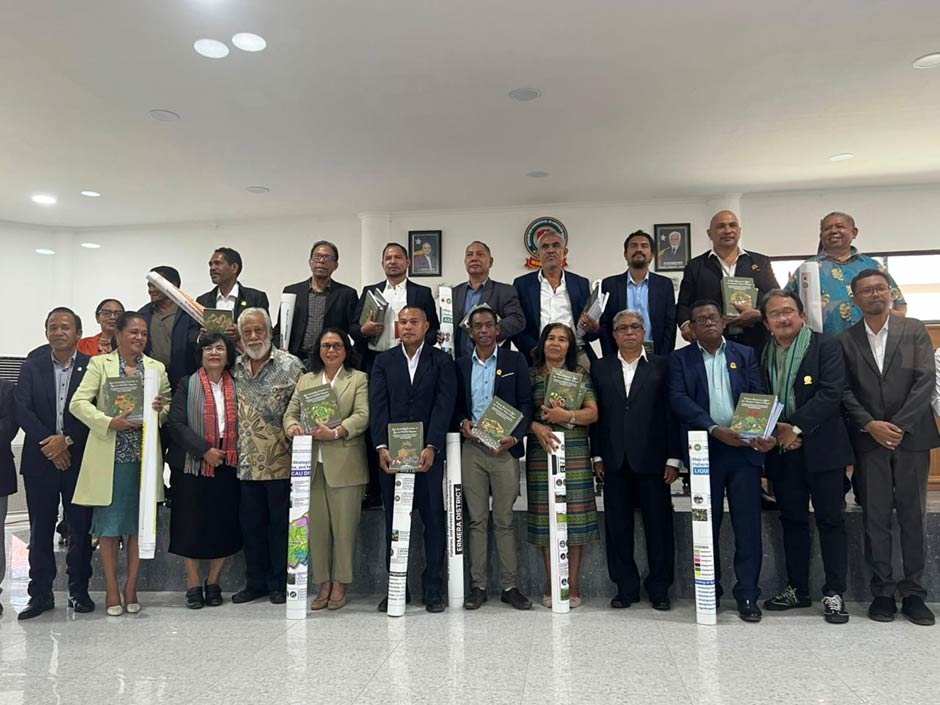
As a concrete output of the research, the Udayana University team handed over a land suitability evaluation guidebook, map albums, thematic maps for each municipality and ministry, and geospatial data that can later be further developed into a Web-GIS and a national geoportal for Timor-Leste. The handover was carried out symbolically to the Minister of MAPPF and the Prime Minister of Timor-Leste, followed by a symbolic handover by the Prime Minister to municipal leaders and heads of related technical offices as a form of shared commitment to implementing the research results in the field.
In his remarks, Vice Rector III of Udayana University, Prof. Alit Susanta Wirya, emphasized that this cooperation should not stop at the final report. According to him, the research results should instead serve as a starting point to open opportunities for further collaboration in organic agriculture, smart farming, data-based precision agriculture, strengthening soil and water laboratories, seed and feed development, land rehabilitation, mangrove strengthening and coastal aquaculture, as well as integrated geospatial systems for public policy. On a broader scale, the cooperation also has the potential to expand into other interrelated sectors, including agrotourism, ecotourism, and regional economic development based on sustainable landscapes.
No fewer than 500 participants were present, including ministry staff, technical service representatives from each municipality, local government officials, academics, and various development stakeholders. This very large and cross-level government participation confirms that the results of the collaborative research between the Faculty of Agriculture and Timor-Leste have been positioned as a strategic state document, not merely an academic output, but as an important reference for decision-making, the formulation of priority programs, and the implementation of Timor-Leste’s national development in the future.
The series of activities concluded with an exchange of cultural souvenirs between the two countries. Timor-Leste presented tais cloth as a symbol of the nation’s cultural identity and honor, while the Udayana University delegation presented Balinese songket cloth as a symbol of friendship, respect, and increasingly close international relations. The moment reinforced the message that academic collaboration not only builds knowledge, but also bridges friendship, mutual trust, and broader future cooperation.
Gallery
UDAYANA UNIVERSITY