 ENG
ENG
 INA
INA
The Integrated Pest Management Laboratory
About the Laboratory
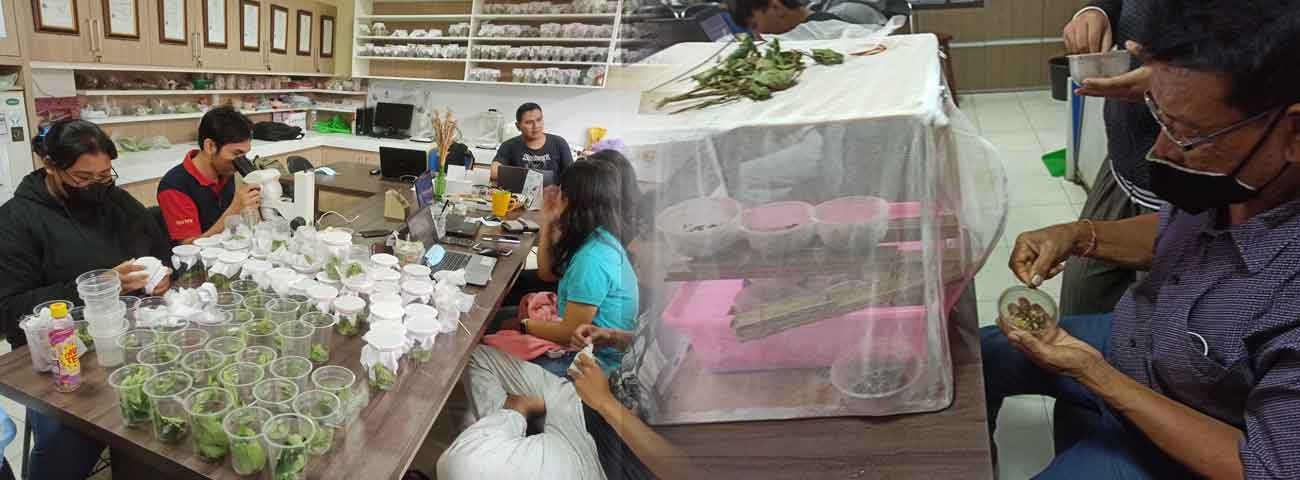
The Integrated Pest Management Laboratory (IPMLab) is an educational laboratory under the Faculty of Agriculture, Udayana University. The laboratory supports practical courses, undergraduate thesis research, as well as master’s theses and doctoral dissertations for postgraduate students. In addition, IPMLab facilitates research activities conducted by lecturers and provides testing services for pesticide active ingredients, including insecticides, fungicides, molluscicides, rodenticides, and plant growth regulators for industry and business sectors.
As an education-based laboratory, IPMLab has established collaborations with various research institutions and laboratories at both national and international levels. To date, IPMLab has trained students and participants in education and training programs in terms of knowledge, attitudes, and practical skills at both laboratory and field scales. These activities aim to improve capabilities in data tabulation and analysis, data interpretation, and scientific report writing as part of strengthening students’ self-capacity and soft skills, while also supporting the hard skills obtained through formal academic learning. Therefore, these activities are expected to provide students with adequate preparation to enter professional careers and community engagement. The types of testing studied and practiced include toxicity tests and efficacy tests.
Vision
To become an outstanding laboratory capable of supporting the development of science and technology in plant protection in a valid and sustainable manner.
Mission
• Providing support for educational processes within the Faculty of Agriculture, Udayana University related to Integrated Pest Management practices.
• Conducting research, development, and dissemination of research findings related to Integrated Pest Management science and technology.
• Carrying out community service activities related to Integrated Pest Management strategies and technologies.
• Establishing research and community service collaborations with other universities, research institutions, and industries at regional, national, and international levels.
Objectives
• Enhancing student capacity and competence through practical laboratory activities.
• Providing access and services for all users of practical and research facilities, including students, lecturers, community groups, and business and industrial sectors.
Laboratory Head
Prof. Dr. Ir. I Wayan Supartha, M.S.
NIP. 195703301986011001HEAD OF LABORATORY
Expert Team
Services
Student Practicum• Conducting educational practicums related to courses affiliated with IPMLab, including Insect Ecology, Biological Control, Plant Pests, Pest Forecasting Systems, Pesticides, and Application Techniques.
• Assisting students in morphometric identification of insect pests and facilitating molecular identification techniques.
• Assisting students and lecturers in producing standardized insect specimen photographs for publication purposes.
• Assisting students in action research and dissemination of pest and disease control technologies during Community Service Programs (KKN).
Research and Development• Providing quality testing services for active ingredients of insecticides, fungicides, molluscicides, rodenticides, herbicides, acaricides, and insect growth regulators.
• Providing quality testing services for biological control agents.
• Providing pesticide residue testing services on plants.
Consultation, Training, and IPM Technology Assistance• Providing training and assistance in IPM technology for farmer groups and government agencies.
• Providing consultation services regarding invasive pests and major plant diseases in food crops, horticulture, and plantation crops.
• Providing biological agents such as parasitoids, pathogens, antagonists, and pest monitoring facilities.
• Providing pest identification services through morphometric and molecular approaches.
• Providing training and mentoring in IPM technology.
Activities and Experience
- Training and mentoring on IPM technology for cocoa pests and diseases in Busungbiu Buleleng, Selemadeg Tabanan, and Petang Denpasar, Bali (2007–2008), funded by the Bali Provincial Government.
- Laboratory training and workshops on pests and quarantine pests in Timor Leste for quarantine officers (June–August 2010), funded by the Ministry of Agriculture and Fisheries, Timor Leste.
- Training and mentoring on IPM technology in rice–gonda intercropping systems using the jajar legowo system in Blahbatuh and Gianyar Districts (2019), funded by the Gianyar Regency Government.
- Training and mentoring on IPM technology for citrus commodities in Payangan District, Gianyar (2018), funded by the Gianyar Regency Government.
- Training and mentoring on IPM technology in shallot and chili intercropping systems in Blahbatuh and Sukawati Districts, Gianyar Regency (2017), funded by the Gianyar Regency Government.
- Training and mentoring on IPM technology for farmer groups in potato commodity development projects initiated with 1 hectare planting in Maubessi and continued in Hatubuilico, Ainaro and Maubessi, Aileu, Timor Leste (2010–2011), funded by the Ministry of Agriculture and Fisheries, Timor Leste.
- Education and training on pest surveillance and quarantine pests for agricultural and quarantine officers in Timor Leste (May–August 2023), funded by the Ministry of Agriculture and Fisheries, Timor Leste.
- Conducting efficacy tests of insecticides, fungicides, and herbicides on food crops, horticultural crops, and plantation crops since 2017 until present, including consultation services related to invasive pests and diseases.
- Identifying new invasive pest species on food crops, horticultural crops, and plantation crops using morphometric and molecular approaches.
- Organizing workshops and scientific seminars to obtain updated information and recent scientific developments related to IPM concepts, policies, strategies, and tactics required by educational institutions, practitioners, and industries.
Collaborative Partners in the Last 10 Years
• Ministry of Agriculture and Fisheries, Timor Leste
• Universiti Putra Malaysia, Malaysia
• Universiti Kebangsaan Malaysia, Malaysia
• National Research and Innovation Agency (BRIN), Cibinong
• Nidom Foundation, Surabaya
• INSTIKI, Denpasar
• Sam Ratulangi University, Manado
• Gianyar Regency Government, Gianyar
• Tadulako University, Palu
Research Topics and Scope of Research Activities
- Identification and monitoring of endemic and invasive pest outbreaks in agricultural crops.
- Development of diagnostic methods for identifying and monitoring pest and disease species in specific geographical regions and crop commodities.
- Evaluation of climate change impacts on population dynamics, community structure, pest and disease severity, and the performance of natural enemies in agricultural ecosystems.
- Engineering IPM technologies to reduce potential risks to human health and safety caused by pest attacks and their management strategies.
- Economic and social analysis, adoption and implementation of IPM practices, and evaluation of IPM benefits in food crops, horticulture, and plantation crops.
- Evaluation of negative environmental impacts caused by pest attacks and their management practices, including habitat engineering to improve the numerical and functional responses of local natural enemies.
- Basic research supporting IPM in food crops, horticulture, and plantation crops, as well as the development of biointensive IPM systems in organic farming.
- Research on new biotechnology and digital-based technologies.
UDAYANA UNIVERSITY